

What Do Animals Do In The Carbon Cycle
VIDEO: What is the carbon cycle? Here's an overview in under two minutes. Transcript
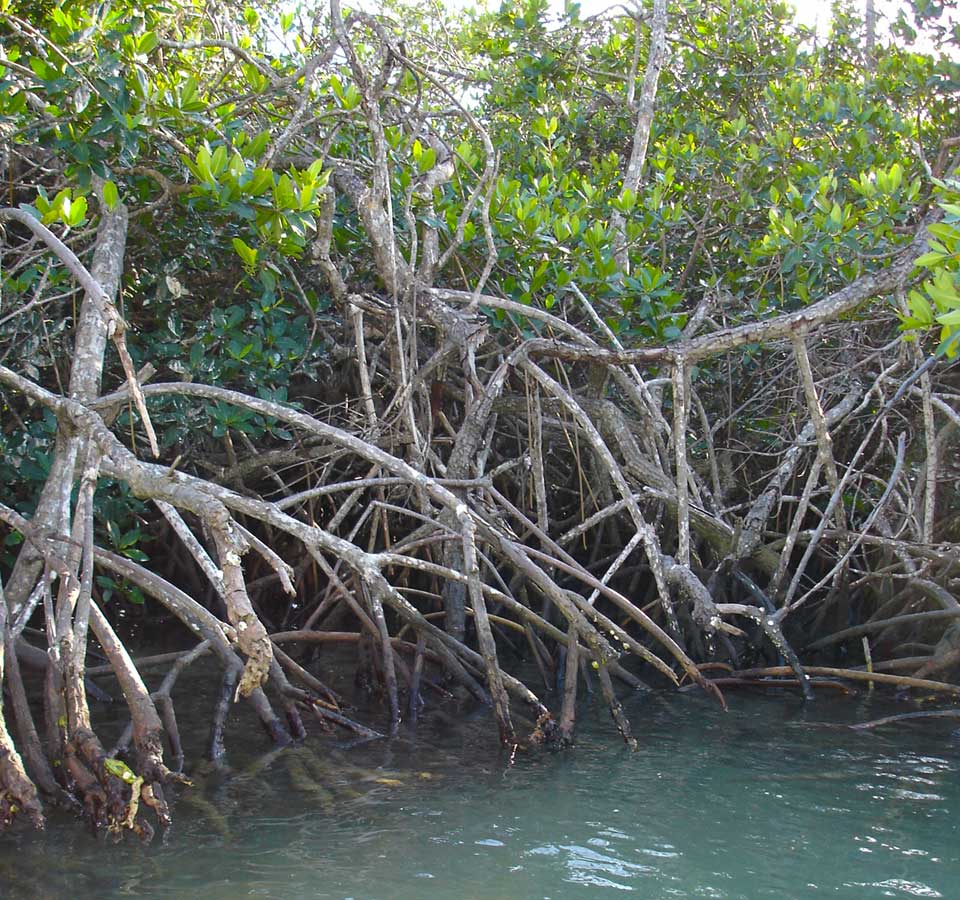
Blue Carbon
Blueish carbon is the term for carbon captured by the world's bounding main and littoral ecosystems. Body of water grasses, mangroves, salt marshes, and other systems forth our coast are very efficient in storing CO2. These areas also absorb and store carbon at a much faster rate than other areas, such as forests, and tin continue to do so for millions of years. The carbon found in coastal soil is often thousands of years old. When these systems are damaged or disrupted by human action, an enormous amount of carbon is emitted back into the atmosphere, contributing to climate change.
Carbon is the foundation of all life on Earth, required to form complex molecules like proteins and DNA. This element is besides establish in our atmosphere in the form of carbon dioxide (CO2). Carbon helps to regulate the Earth's temperature, makes all life possible, is a key ingredient in the food that sustains us, and provides a major source of the energy to fuel our global economic system.
The carbon cycle describes the process in which carbon atoms continually travel from the temper to the World so back into the atmosphere. Since our planet and its atmosphere course a closed environs, the amount of carbon in this system does not change. Where the carbon is located — in the atmosphere or on World — is constantly in flux.
On Earth, most carbon is stored in rocks and sediments, while the rest is located in the body of water, atmosphere, and in living organisms. These are the reservoirs, or sinks, through which carbon cycles.
Carbon is released back into the atmosphere when organisms die, volcanoes erupt, fires blaze, fossil fuels are burned, and through a variety of other mechanisms.
In the example of the sea, carbon is continually exchanged between the sea's surface waters and the atmosphere, or is stored for long periods of time in the ocean depths.
Humans play a major role in the carbon cycle through activities such every bit the burning of fossil fuels or land evolution. As a outcome, the amount of carbon dioxide in the atmosphere is rapidly rising; it is already considerably greater than at any fourth dimension in the concluding 800,000 years.
Video Transcript
What is the carbon cycle? Carbon is the chemical backbone of all life on Earth. All of the carbon we currently have on Earth is the same amount we take always had. When new life is formed, carbon forms fundamental molecules like protein and DNA. It's also found in our atmosphere in the class of carbon dioxide or CO2. The carbon cycle is nature's way of reusing carbon atoms, which travel from the atmosphere into organisms in the Earth and and then back into the atmosphere over and over again. Well-nigh carbon is stored in rocks and sediments, while the rest is stored in the ocean, atmosphere, and living organisms. These are the reservoirs, or sinks, through which carbon cycles. The bounding main is a behemothic carbon sink that absorbs carbon. Marine organisms from marsh plants to fish, from seaweed to birds, also produce carbon through living and dying. Sometimes expressionless organisms become fossil fuels that go through combustion, giving off CO2, and the cycle continues.
Source: https://oceanservice.noaa.gov/facts/carbon-cycle.html
Posted by: keeleycopichatte59.blogspot.com
0 Response to "What Do Animals Do In The Carbon Cycle"
Post a Comment