

How Many Hours A Day Animals Sleep
Animals That Sleep the Least
Larger animals tend to need less sleep than smaller ones, and those that graze slumber less than carnivores that consume big meals. Here are the animals that need the least amount of sleep:
- Bullfrogs go without sleep for months at a time! Though they close their eyes and residuum, they remain alert and will respond to painful stimuli and show changes in respiration. They do sleep deeply during hibernation in the wintertime.
- Impalas most never sleep. Male impalas in detail rarely let their guard down equally they're watching the herd.
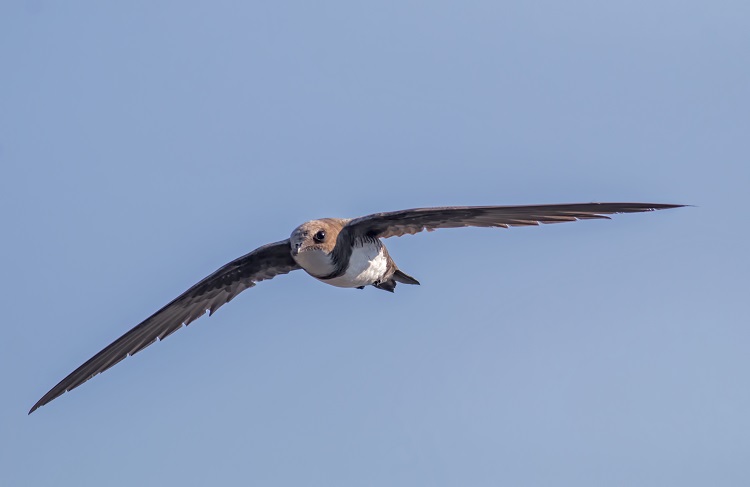
- Alpine swifts fly from Switzerland to West Africa for vi months straight without stopping! It'due south unclear if they sleep or rest while in flight.
- Walruses can go for 84 hours with no slumber! When they do slumber, they can sleep anywhere on land, on the bottom of the ocean, even floating. Sometimes they'll bite downwardly onto ice sheets with their teeth while they sleep.
- Orca calves spend the first few months of their lives pond around, even if their parents are asleep. It'southward believed that this keeps them safe from predators and keeps them warm equally they haven't adult blab stores notwithstanding.
- Dolphins slumber with one-half of their brain asleep (called unihemispheric slow-wave slumber or USWS), as many birds do, which means that just i of their eyes will work (the one opposite the hemisphere that is awake). The 1 eye keeps an heart out for predators, and they tin come up to the surface to exhale. Some dolphins will swim while they sleep, others will float and look like a log. Dolphins will slumber with one side of their brain asleep for 2 hours, then switch and slumber with the other side of their brain.
- Giraffes sleep 30 minutes to 2 hours per solar day, oftentimes broken up into smaller sections. Because getting up from the ground takes them a little time, lying down makes them more vulnerable to predators such every bit crocodiles and lions. For this reason, they will oft sleep continuing upwards and may remainder their head on their rumps. Until the 1950s, researchers believed that they didn't sleep at all.
- Horses slumber 2.v hours/night and tend to nap for xv minutes at a time.
- Deer need 3-4 hours in 24 hours.
- Elephants slumber three-iv hours per dark. Because of their size, they need to spend up to eighteen hours per day eating 200-600 pounds of food/day! They sleep standing, leaning on a tree or termite mound, or lying on their side. If they lie on their side their sleep is less than 30 minutes, preventing their internal organs from being crushed.
- Sheep sleep less than 4 hours per night, and slumber huddled together as some other flock animals do.
- Goats and cows sleep four hours per 24-hour interval, divided into short periods. Near of their days are spent looking for food, and when they practise sleep, they sleep in groups and accept turns to keep watch for predators.
- Ants take i-minute naps several times equaling 4 to v hours per day. However, the queen pismire sleeps up to nine hours/twenty-four hour period.
Animals That Slumber the Most
- Koalas sleep up to 22 hours/day; they don't slumber because they need to - they exercise it for pleasure!
- Pocket mice weigh as much equally 5 newspaper clips. These trivial rodents sleep up to 20 hours/solar day.
- Sloths are slow-moving creatures that sleep upwardly to 20 hours/day in a tree, but coming downward to relieve themselves, and so burying it, then looking for some other tree. Sloths don't ever move slowly. They can motion as fast equally a cat when in danger. They move slowly just to conserve energy.
- Chocolate-brown bats slumber upside downwardly. They spend nearly xx hours/solar day comatose.
- Armadillos sleep a lot due to the weight of their beat out, which is three times its body weight! They slumber 19 hours per day.
- Opossums sleep on average 19 hours/day, possibly due to all of the climbing and jumping they do in copse.
- Lemurs sleep about 16 hours/day. Their need for lots of sleep may be due to the high temperatures of the tropics that they inhabit.

How Much Humans Sleep vs Animals
A man baby sleeps 16 hours/24-hour interval (66.6% of the twenty-four hour period), an developed eight hours (33.3%), and an elderly person 5.5 hours/day (22.9%). How does that compare to animals? According to the University of Washington:
| Species | Boilerplate Total Sleep Fourth dimension in % of 24-hour Menstruation | Boilerplate Total Hours Sleep Time in 24-hr Menstruation (hours/mean solar day) |
|---|---|---|
| Brown Bat | 82.nine% | nineteen.9 |
| Giant Armadillo | 75.4% | 18.1 |
| Python | 75% | 18 |
| Tiger | 65.viii% | fifteen.8 |
| Squirrel | 62% | 14.9 |
| Cat | 50.half-dozen% | 12.1 |
| Mouse | 50.i% | 12.i |
| Domestic dog | 44.3% | 12.6 |
| Birdie | 42.9% | 10.3 |
| Chimpanzee | forty.4% | 9.vii |
| Guppy | 29.ane% | 7 |
What a Domestic dog's Sleeping Position Tells You lot
Dogs go through the same slumber stages as humans; they only spend less time at each sleep stage. And no one knows why, simply big dogs dream longer than picayune dogs, and little dogs dream rapidly and often.
The position a dog sleeps in can tell yous about how they're feeling. A domestic dog sleeping on its side feels prophylactic as its vital organs are exposed. If they're sleeping somewhere new or effectually people who they're not familiar with, they may not sleep on their side.
If a domestic dog sleeps curled upwards in a ball, information technology may exist considering they're non in a comfortable environment and feel more secure protecting their organs, and they tin can become upwards faster, or this may conserve heat.
Puppies will often slumber on their breadbasket so that they can get up quickly and not miss any playtime! If a dog sleeps on its dorsum, it is either very comfortable, as its organs are the most exposed, or it's trying to absurd off. If your dog cuddles with you, it'south showing you affection and trust.
Many dogs will circumvolve before lying down, which is what their ancestors, wolves, would exercise to trample grass down to make a comfy bed. Digging is something their ancestors would do to keep them warm in the winter and absurd in the summer.
If your dog sleeps during the twenty-four hours, information technology may be due to boredom. If in that location'south any kind of noise and their ears perk upward, it ways that they are just waiting for something exciting to happen and aren't in deep sleep.
Cats and Sleep
Cats experience REM (rapid eye movement, the stage of sleep where dreaming occurs) and non-REM slumber, just like humans, and they too dream. Y'all can tell when a cat is in REM when its trunk and face twitches.
An interesting fact almost cats is that even when they're sleeping, they tin can wake upwardly instantly, and they're ready to run or fight.
Cats are normally nocturnal every bit their ancestors hunted at nighttime, and they too have very expert hearing and sight.
They're known to slumber a lot, and it's idea that this is so they can conserve free energy to be able to leap into action at whatsoever moment. And they tend to sleep more than when it's rainy or common cold.
Cats may snore, and sure breeds exercise so more than often because of the structure of their faces, such as Persians and Himalayans.
Fish Rest
Fish don't get to slumber as mammals do, and they don't go through REM sleep, but almost all fish rest. Many fish will reduce their activity levels and metabolism, which saves energy and helps restore the body, and enter a land where they're very relaxed and just occasionally motility a fin to go on their balance. Sharks must remain swimming while resting because they demand to continually laissez passer water over their gills for a constant source of oxygen.
Fish don't close their eyes while asleep considering they don't have eyelids. Sharks are the simply fish that accept eyelids, simply they simply close them while attacking prey.
Some fish will notice a safety identify to rest, such equally an underwater cave, between rocks, or burrowed into the sand, and some will float in place. While asleep, fish will remain somewhat alert to avoid predators. Many fish are active in the twenty-four hour period and rest at dark, while other fish do the reverse.
The just fish that don't sleep are blind, cave-home fish and deep water fish who swim continuously. The theory is that slumber is a fashion to process information and visual stimuli from the day. Since these fish aren't processing whatever information, at that place's no demand for rest.
One species of fish, zebrafish, can as well suffer from sleep deprivation like humans. If a fish can't sleep due to spawning, migration, threats from predators, or some disturbance in their environment, they volition make up for the lost sleep equally shortly equally things return to normal.
Parrotfish have a unique way to protect themselves during their rest periods. They go to the ocean floor and create a large snot bubble around themselves. The predator they're protecting themselves confronting is a blood-sucking parasite chosen a gnathiid. During the day they can seek the service of cleaner fish, such as the bluestreak cleaner fish that will consume the gnathids. Simply at night the cleaner fish aren't active.
Reptiles Dream
Unlike fish, reptiles do experience REM. Whether they dream during REM is unknown, though in that location is some neural activity. Dr. Gilles Laurent told Scientific American, "If you forced me to speculate and to use a loose definition of dreaming, I'd speculate that those dreams are most recent notable events: insects, maybe a place where there are skilful insects, an ambitious male in the next terrarium, etc."
The sleep wheel of lizards merely lasts eighty seconds, compared to a human'south, which lasts from fourscore to 110 minutes, while a cat's is xxx minutes. Lizards will go through 350 full cycles every night, as opposed to 4 or 5 for humans. Simply they seem to get through the same cycles as humans.

Birds Slumber Half-Awake
Like dolphins, many birds will sleep with 1 eye open, and one-half of their brain awake (unihemispheric deadening-wave sleep or USWS) . If they open their right eye, it's the left half of the brain that's awake. They tin can command simply how much of their encephalon is asleep by how broad they open or shut their eye! The amount of sleep and which part of the brain sleeps is determined by which part of the brain has been most active during the day. The parts that were the most active received the most amount of sleep.
Some other factor in the amount of USWS is the risk of assail from predators. Ducks nigh the perimeter of the flock are more probable to first react to threats from predators than ducks in the heart of the flock.
USWS keeps a bird rubber from predators while they slumber. Some birds can fifty-fifty sleep while flying, especially during long migrations, and they're notwithstanding able to navigate. Ducks and geese that fly in J and V formations will use USWS when not in the lead position of the grouping.
Nocturnal birds volition wake up when the sun sets and hunt during the nighttime, but well-nigh birds follow the same diurnal pattern as humans and sleep at nighttime.
For birds that sleep on a perch, when they place weight on their feet, the tendons in their feet tighten which closes their feet, giving them a good grip on the spot they're holding onto. Other birds volition sleep inside of trees, in ground cover, or in the water.
Scientists aren't sure whether birds dream or not, simply in male zebra finches the neurons in the robustus archistratalis (song system of their brains) show spontaneous bursting patterns during sleep, which suggests that they are replaying songs that they've played or heard during the mean solar day.
Octopuses Alter Color in REM Sleep
Octopuses are invertebrates, significant that they don't accept a spine. Octopuses are highly intelligent and go through sleep cycles, including REM sleep.
When they slumber, they go into their homes, narrow their eyes, and become however for long periods. Approximately every 15 minutes they will twitch their tentacles and speedily change color. Scientists used to believe that they were waking upwardly to check for predators merely at present believe that they're in REM sleep. In humans, REM sleep is a sign of dreaming, so it'southward possible that octopuses dream too.

Do Insects Sleep?
The answer almost likely is yes, though they probably don't sleep as humans do. They don't have eyelids, and then information technology'due south non easy to tell if they sleep, but they do have a central nervous arrangement and circadian rhythms, which seem to be of import signs of a life class that require sleep. In full general, insects will relax, stop moving, and some will exhibit external signs of sleep, such as cockroaches that fold their antennae when they sleep. This state is chosen torpor, which isn't exactly sleeping, only similar.
Fruit flies will find a place to rest for 2.v hours. While resting, they don't motion, except for occasional twitching, and they don't respond to sensory stimuli.
Fruit flies that tin can't rest will then rest longer than normal to brand upward for the lost rest. Like to humans, they will be slower at learning when tired, such as taking longer to detect their manner through a maze. In ane experiment fruit flies were denied balance for so long that they died. In inquiry with honeybees, the bees were unable to perform normal tasks when rest-deprived.
Examples of insects that rest during the twenty-four hour period are cutworms that eat leaves at night to avert predators, crickets, and bed bugs that feed on humans who slumber at night. Many other insects residue at night.
Insects have circadian rhythms like other animals and humans, responding to changes in light and temperature. And but like humans who are given caffeine, insects' power to residue is also affected.
How Do Animals Sleep Standing Up?
Giraffes, elephants, camels, horses, and cows can sleep standing up by locking their legs so their muscles aren't engaged, which is chosen a stay apparatus. In this way they're less vulnerable to predators because they can more hands run away, not having to take a few seconds to stand upwardly earlier running. They aren't able to engage in REM sleep in this posture nonetheless, so they also demand to lie down. REM sleep causes muscle atonia (a sort of muscle paralysis) which would brand them fall over.
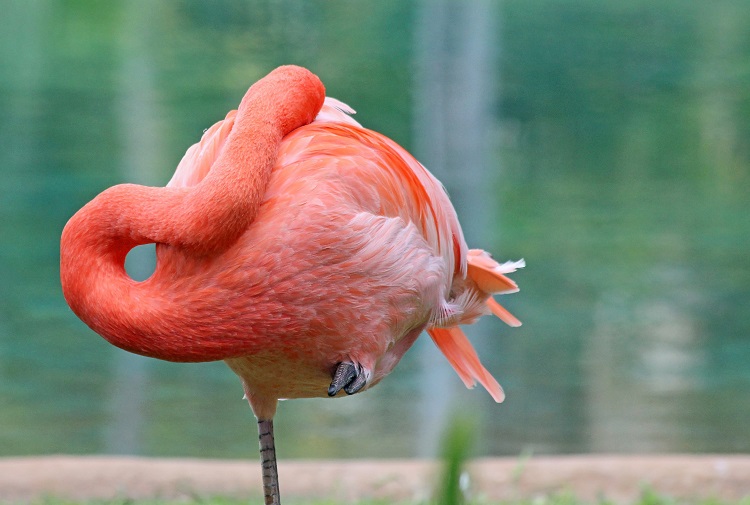
Birds can likewise sleep standing upwards, which is usually when they tin't find a comfortable place to sleep. Flamingos have to sleep standing upwards as they alive in caustic salt flats.
Hibernation
Animals will hibernate for weeks or months at a time when food becomes scarce. In cold conditions, it's called hibernation, just information technology can occur in warm weather condition too (called estivation). During hibernation, the heart charge per unit and breathing rate both drib significantly, the cadre temperature drops, withal the animal volition have brief bouts of wakefulness. During this period the animal won't beverage, swallow, or relieve itself. Hibernating animals will usually eat a slap-up deal beforehand to develop fatty stores to alive off while hibernating.
Surprisingly, for some animals hibernation isn't restful equally they need to slumber later hibernation!
Animals that hibernate include:
- prairie dogs
- skunks
- bears
- bumblebees (only the queen)
- snakes
- box turtles
- country snails
- bats
- wood frogs
- fat-tailed dwarf lemurs
- chipmunks
- hedgehogs
Why Animals Sleep Differently
In general, large mammals slumber less than minor ones, which is believed to explain almost 25% of the difference in sleep amounts for different mammals. Larger mammals also have longer sleep cycles. Other factors include basal metabolism and brain mass.
Animals with large brains require more REM sleep, as REM slumber helps the encephalon consolidate memories and larn.
Protection against predators is an of import gene in how animals sleep, and for how long. For example, equally mentioned, many birds volition sleep with i eye active and half of their brain awake and so they can fly to prophylactic if attacked.
Carnivores tend to sleep more than than herbivores, almost probable considering herbivores have to spend many hours eating every 24-hour interval whereas carnivores can take in a big number of calories in one meal.
Some species such every bit lions sleep in short periods during the day and at night so they're able to take advantage of feeding opportunities.
Other Interesting Beast Sleep Behaviors
Otters will float on the h2o lying on their backs, ofttimes wrapping themselves in seaweed. Floating in water keeps them safe from predators on land, and wrapping themselves in seaweed keeps them from floating abroad. As many as 100 otters tin exist seen wrapped in seaweed, which is called an otter raft. Otters volition often link paws together to keep from floating off.
Chimpanzees will build sturdy nests lined with leaves in trees to sleep in.
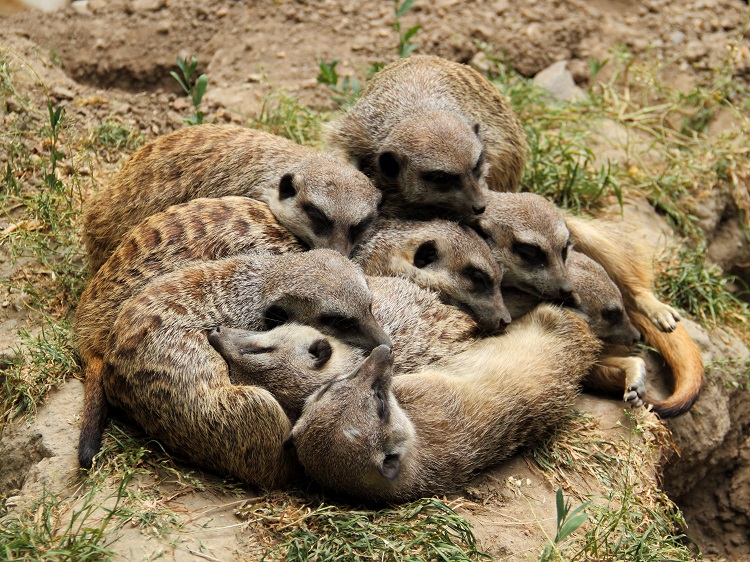
Meerkats will sleep in piled groups of up to twoscore meerkats with the alpha males and blastoff females as far away from possible threats. Communities of meerkats are chosen gangs or mobs and utilize closeness to go on each other warm.
Walruses can sleep on land or in the water. To continue their caput above water when sleeping, they fill their pharyngeal pouches, located on each side of their esophagus.
Some speculate that great white sharks face the current while asleep and then they don't accept to keep moving, as the current will laissez passer water over their gills providing them oxygen without needing to swim.
Snails can go into a hibernation period of up to three years! A famous story involves a British museum officer who attached an Egyptian desert snail to an identification card. Iv years later there were traces of slime on the bill of fare and when the staff member removed the shell from the carte, the animal crawled out! Snails secrete a layer of mucus around them before hibernation to prevent them from dying due to dehydration in a process called estivation.
Guinea baboons sleep on the tops of copse on their heels so they can run off immediately if attacked.
Most animals will sleep in several sessions throughout the day (polyphasic) whereas humans volition usually sleep in one session (monophasic).
Cows like to sleep shut to their relatives and their position is adamant by their rank in the social hierarchy.
Male malachite sunbirds sleep with their bright yellow pectoral tufts fluffed upwards to give the impression to predators that they're looking into the eyes of a big mammal.
Animal Sleep FAQ
Here are the answers to our most frequently asked questions well-nigh animal sleep habits and routines.
The animals that sleep the least include bullfrogs, impalas, alpine swifts, walruses, orca calves, dolphins, giraffes, horses, deer, elephants, sheep, goats, cows, and ants.
References
Source: https://startsleeping.org/animal-sleep/
Posted by: keeleycopichatte59.blogspot.com
0 Response to "How Many Hours A Day Animals Sleep"
Post a Comment